
Glass Door Locking for Modern Interior Spaces
Glass Door Locking for Modern Interior Spaces
A glass wall can make a workplace feel open, bright, and organized, but it still needs to create a secure room when privacy matters. The right glass door locking system gives conference rooms, private offices, salon suites, home offices, and closets a dependable point of control without disrupting the clean lines that make glass interiors so effective.
The best choice is rarely just a question of selecting a lock body. It depends on the door type, panel configuration, glass thickness, frequency of use, desired privacy level, and whether the space needs to be secured from one side or both. A well-specified locking system should feel intuitive, operate quietly, and support the long-term performance of the entire glass door assembly.
What Glass Door Locking Needs to Do
Interior glass doors do not always need the same level of security as an exterior entry. In many offices, the primary purpose of a lock is controlled privacy: a team meeting, a client call, a counseling session, or a focused work period should not be interrupted by someone opening the door without permission. In homes, the need may be visual separation and personal privacy for a bedroom, office, or closet area.
That does not mean the hardware can be treated as an afterthought. Glass doors place different demands on locks than conventional wood doors. The hardware must be engineered for the door’s weight and movement, mounted without compromising the glass, and aligned accurately with a strike, receiver, or adjacent panel.
For sliding glass systems, locking also works with the door’s travel and bottom-wheel operation. A door that slides smoothly but rattles at the closed position, misses its strike, or requires force to lock will feel unfinished. The best systems are designed as one coordinated assembly, where the frame, track, rollers, guides, handles, and lock work together.
Start With the Door Configuration
The lock style should follow the configuration, not the other way around. A hinged glass swing door, a single sliding panel, a bypass closet door, and a sliding conference room door all close differently. Each requires a locking approach built for that movement.
Sliding glass doors
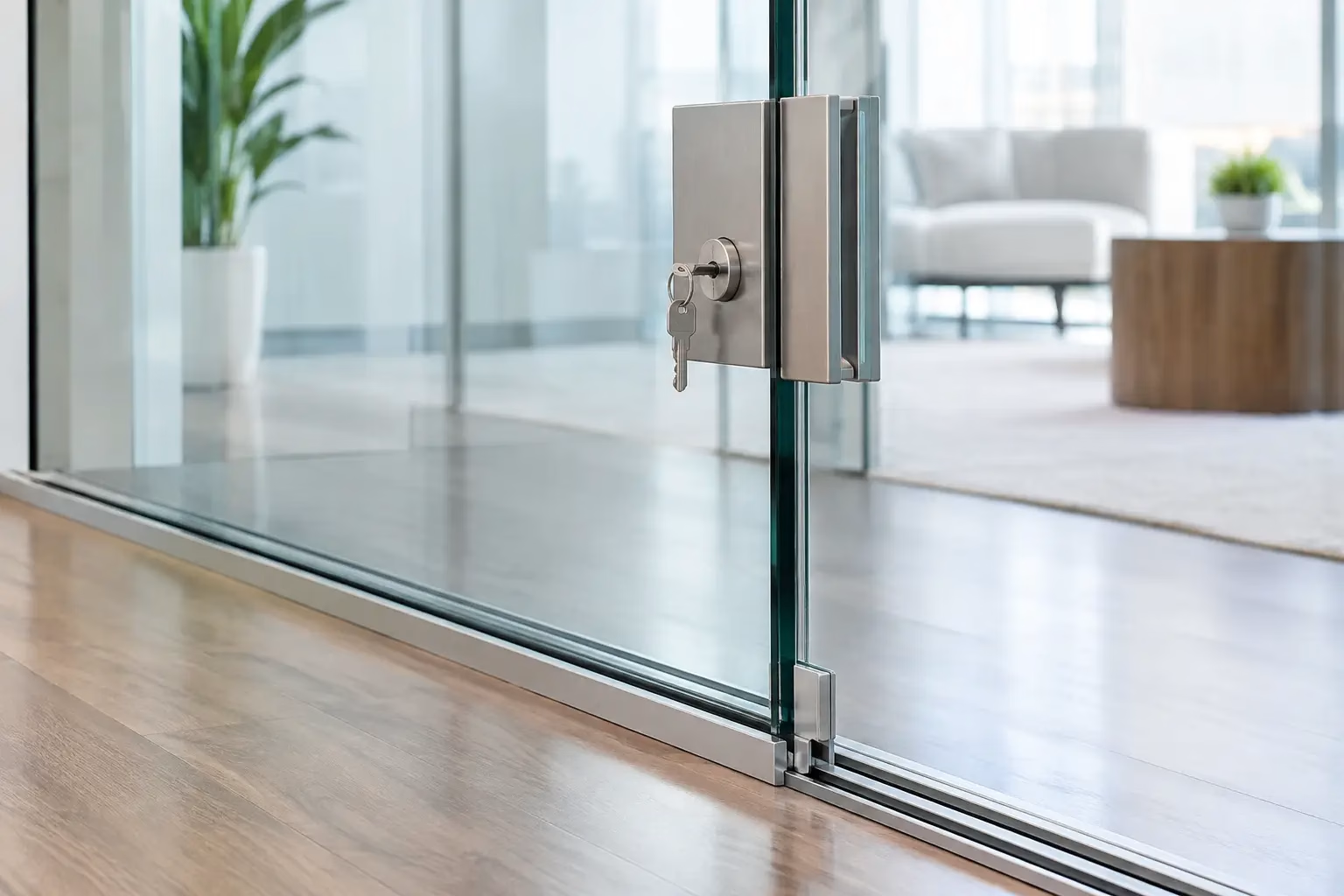
Sliding doors commonly use a hook lock, deadlock, or mortise-style locking mechanism that engages a strike at the jamb or a receiver on an adjacent glass panel. Hook-style hardware is particularly useful because it resists the lateral movement of a sliding door. Rather than relying on simple pressure against a frame, the lock positively catches at the closed position.
For an office conference room, a keyed exterior cylinder paired with an interior thumbturn can provide controlled access while allowing occupants to exit easily. For a home office or bedroom divider, a privacy lock may be sufficient. The right answer depends on whether the room needs casual privacy or managed access.
Hinged glass doors
Swing doors often use patch fittings with a lock integrated into the glass door hardware, or a lock body mounted at the edge of the panel. These systems can be paired with a floor strike, header-mounted receiver, or wall jamb strike depending on the opening design.
Alignment matters more than many buyers expect. Frameless glass has very little tolerance for hardware that is installed out of position. The latch should engage cleanly without pushing, lifting, or twisting the door. When the door is part of a glass office partition, the lock should also preserve the refined appearance of the full wall system.
Double doors and glass-to-glass openings
Double glass doors need a clear active and inactive door strategy. One panel may secure with a flush bolt or top-and-bottom locking point, while the active panel locks into it. This can create a wide opening when needed while maintaining a secure closure during normal use.
Glass-to-glass locks are another option for frameless partition systems. They can connect a door directly to a fixed sidelight or adjacent glass panel, reducing the need for visible framing. This approach supports a minimal architectural appearance, but it requires accurate fabrication and professional attention to glass cutouts, hardware compatibility, and panel alignment.
Choose the Right Level of Privacy and Access Control
A lock should match how the room is actually used. Over-specifying hardware can add cost and complexity. Under-specifying it can leave occupants without the privacy or access control they expected.
A simple passage function works for spaces that only need a pull handle and positive closure. A privacy function is better for rooms that need temporary, occupant-controlled privacy, such as a residential office, wellness room, changing area, or small meeting room. Keyed locks are appropriate when managers, administrators, or homeowners need controlled entry from the outside.
For higher-traffic commercial areas, access control may be the better fit. Electronic strikes, card access, keypad entry, or other managed systems can be incorporated when the opening design supports them. This requires early coordination. Glass door hardware, wiring routes, header conditions, and emergency egress requirements should be planned before fabrication rather than added after installation.
For any occupied commercial space, life safety comes first. A locked interior door must still allow safe egress according to applicable building code and local requirements. Hardware selection should be reviewed with the project architect, contractor, facility team, or qualified installer when code compliance is part of the scope.
Safety Comes Before Lock Strength
Glass door locking should be strong enough for its intended use, but a stronger lock alone does not make the system safer. The full assembly matters: tempered safety glass, appropriate panel thickness, engineered hardware, reliable rollers or hinges, properly positioned guides, and a stable receiving surface.
Never treat standard glass like a field-modifiable material. Glass doors are fabricated with precise cutouts and edge preparation for their designated hardware. Drilling, cutting, or altering tempered glass after production can cause immediate breakage. If a lock is being upgraded or changed, confirm whether the existing door has the correct cutouts before ordering new hardware.
Sliding systems deserve special attention at the bottom of the door. A properly engineered bottom guide and wheel design helps prevent unwanted sway while maintaining controlled movement. In applications where safety and room security both matter, bottom-wheel locking design can help keep the panel stable in its intended closed position while preserving smooth, quiet operation.
The hardware finish also deserves consideration. Brushed stainless steel, matte black, and other durable finishes should be selected for both design consistency and expected wear. Busy office corridors, salon environments, and frequently used home entries can show fingerprints and surface wear quickly. Choose a finish that fits the maintenance expectations of the space.
Plan Locking With the Entire Glass System
The most successful projects make locking decisions early, alongside the opening width, panel layout, handles, wall condition, and installation method. Waiting until the glass is ordered can limit options or create unnecessary change orders.
Before finalizing a system, confirm four practical details:
- The door type and direction of travel, including whether it slides, swings, bypasses, or meets another panel.
- The required function, from simple privacy to keyed access or managed electronic entry.
- The receiving condition, such as a wall jamb, framed opening, fixed glass panel, or second door.
- The operational details, including handle clearance, floor conditions, soft-close components, and how the door will be used every day.
These decisions are especially valuable in demountable office systems. A movable glass partition can support changing team sizes, new room layouts, or future relocations, but its locking approach needs to remain compatible with those changes. Selecting modular, serviceable hardware helps protect the long-term value of the investment.
Installation Quality Determines Daily Performance
Premium hardware cannot compensate for an inaccurate installation. A lock that is only slightly misaligned may still close, but it can create noise, drag, unreliable latching, and unnecessary wear over time. In a polished office or residence, those small frustrations are noticed every day.
Professional measurement is particularly helpful for custom glass systems, where floor variation, wall plumb, ceiling conditions, and opening dimensions can affect alignment. For projects using standard-size components, careful verification before ordering remains essential. Measure the finished opening, not an early framing condition that may change after flooring, drywall, or trim work.
Installation coordination is also useful when a project includes multiple rooms, large panels, access-control requirements, or unusual wall conditions. Doors22 designs custom glass systems around exact measurements and practical operating requirements, helping clients specify a solution that looks refined and performs as intended.
A glass door should close with a controlled motion, align cleanly at the lock point, and give users confidence that the space is private when it needs to be. Start with how the room will be used, select hardware designed for that configuration, and make locking part of the system design from the first measurement. For a tailored solution, request a free quote within 24 hours and plan the details before the glass is fabricated.
 Share this post with others


