
Can Sliding Doors Lock Securely? What Matters
Can Sliding Doors Lock Securely? What Matters
A sliding glass door should feel open when it is in use and firmly controlled when privacy, access, or safety matters. So, can sliding doors lock securely? Yes, provided the lock, glass, track, frame, and installation are specified as one coordinated system. A decorative sliding panel with an added latch is not the same as an engineered door system built for daily performance.
For offices, clinics, salons, conference rooms, home offices, and residential interiors, the right locking approach depends on what the door needs to accomplish. Some spaces need visual privacy and a clear occupied or vacant signal. Others need to limit entry, protect confidential conversations, or create a stable room divider. The best solution balances security expectations with clean design, quiet operation, and the flexibility that makes sliding glass systems valuable in the first place.
Can Sliding Doors Lock Securely in Interior Spaces?
Interior sliding doors can lock securely, but “securely” means different things in different applications. A lock on a conference room glass door may be intended to prevent interruption during a meeting. A lock for a private office, wellness room, or residential home office may need keyed access control. A closet or decorative room divider might only need a positive latch that keeps the panel from drifting open.
This distinction matters because interior sliding glass doors are generally not designed to replace an exterior entry door, perimeter security door, or fire-rated assembly unless they have been specifically engineered and certified for that role. A beautiful glass partition can define a private room and control access within a building. It should not be assumed to provide the same forced-entry resistance as a commercial storefront entrance.
When specified correctly, a sliding glass system provides dependable day-to-day locking performance without sacrificing the light flow and visual connection that fixed walls often eliminate.
The Lock Type Determines the Level of Control
Most sliding door security begins with selecting a lock designed for sliding movement. Swing-door hardware cannot simply be adapted to a moving glass panel and expected to perform consistently. The lock must align precisely each time the panel reaches its closed position.
Hook Locks for Reliable Engagement
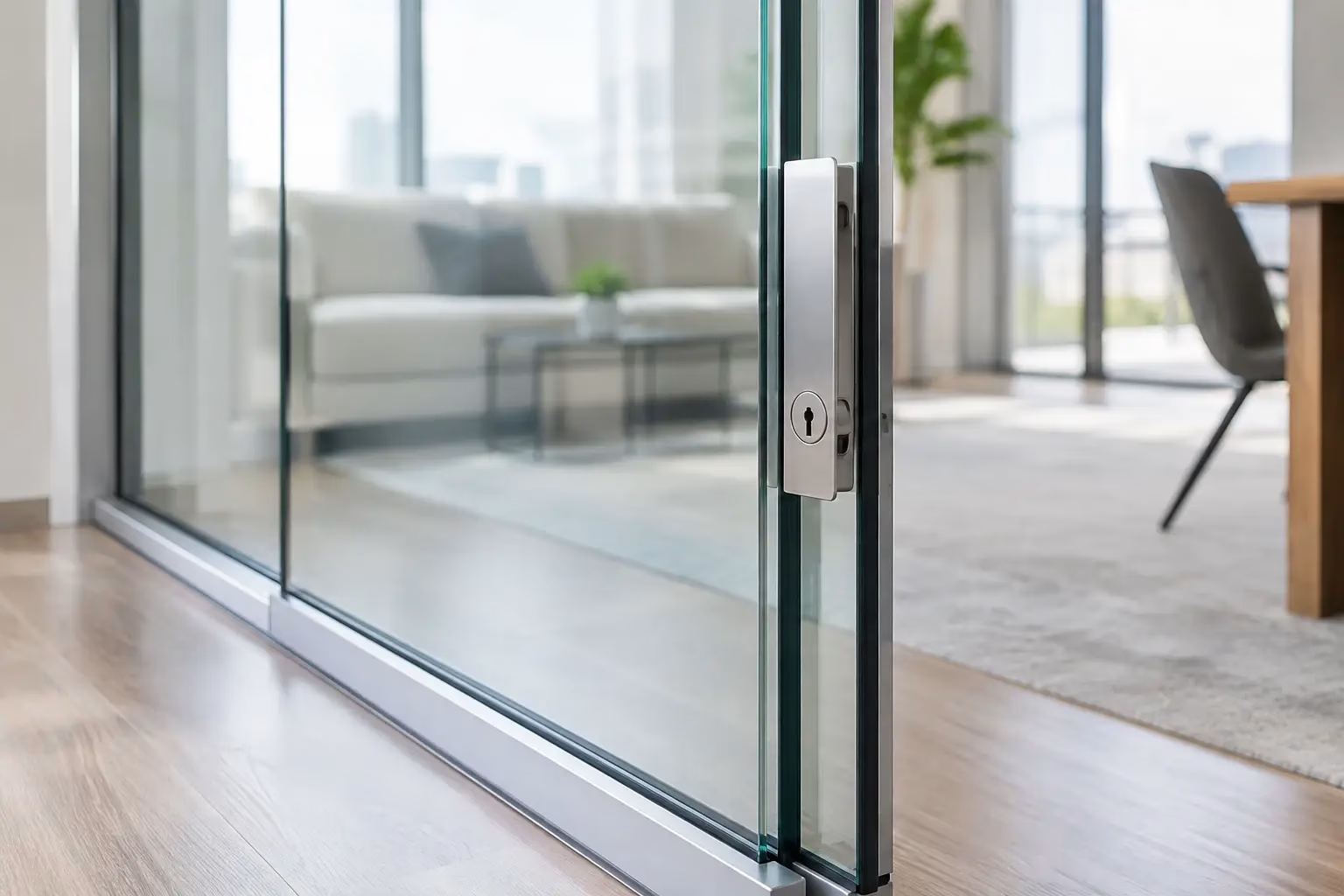
A hook lock is a common and effective option for sliding glass doors. Rather than relying on a simple spring latch, the lock engages with a keeper or strike at the frame or adjacent panel. Once engaged, the hooked bolt helps resist the door being pulled or slid open from the opposite side.
For private offices, conference rooms, and enclosed work areas, hook locks offer a refined appearance and dependable operation. They can be configured with a thumbturn, privacy indicator, key cylinder, or other access-control format depending on the intended use.
The quality of the strike is just as important as the lock body. A lock can only hold as well as the component it engages. The keeper must be securely integrated with the receiving frame, wall jamb, or fixed glass panel so repeated use does not shift its position.
Privacy Locks for Occupied Rooms
Privacy locks are designed for spaces where users need temporary control rather than key-based security. They are practical for consultation rooms, wellness suites, executive offices, and residential workspaces. Many configurations include an occupied or vacant indicator, allowing people outside the room to see whether entry is appropriate.
This approach is efficient when the goal is privacy, not restricted access. It also avoids handing out keys or managing credentials for rooms that are shared throughout the day.
Keyed Locks for Controlled Access
When access must be limited to authorized users, keyed sliding door locks are the better choice. They work well for management offices, records rooms, private studios, secured storage areas, and other interior applications where a lock needs to do more than signal occupancy.
Keyed hardware should be selected early in the design process. The glass preparation, lock body, strike location, and frame conditions all need to be compatible. Retrofitting a lock after the system is installed can be possible in some cases, but it is rarely as clean or cost-effective as planning for it from the start.
The Track and Panel System Must Support the Lock
A lock is only one component of door security. If the door panel can lift out of the track, flex excessively, or stop short of its intended closing position, even high-quality locking hardware cannot perform as designed.
Well-engineered sliding systems use precise top and bottom guidance to keep the panel aligned. Bottom-wheel systems can provide stable movement and reduce the load carried overhead, particularly with larger or heavier glass panels. Safety-focused wheel and guide design helps keep the panel operating within its track path while preserving smooth, quiet travel.
Anti-lift or anti-jump features are also valuable. These components help prevent a panel from being raised or dislodged from the track during normal use. They are not a substitute for a lock, but they support the locked condition by keeping the door correctly positioned at the strike.
The frame or wall structure matters, too. A lock installed into a lightweight, poorly reinforced jamb may not hold its alignment over time. In a commercial glass partition, the receiving condition should be designed to accept the hardware load and repeated closing cycles. For residential installations, the same principle applies: secure mounting behind finished surfaces is more important than an attractive escutcheon plate.
Glass Choice Affects Safety and Confidence
Tempered safety glass is a standard choice for interior sliding glass doors because it is built to perform differently from ordinary annealed glass if it breaks. For applications requiring additional retention, acoustic performance, or a more controlled break pattern, laminated glass may be appropriate.
Glass thickness should be selected based on panel size, hardware compatibility, and the system’s engineering requirements. Thicker glass is not automatically better if the rollers, locks, and track are not designed for its weight. The goal is a balanced assembly in which every component is rated for the panel it supports.
For private rooms, clear glass can be paired with frosted, tinted, reeded, or patterned finishes to improve visual privacy while retaining natural light. This is often a better design answer than treating the lock as the only privacy feature. A locked transparent door may control entry, but it does not prevent visual distraction.
Installation Accuracy Is a Security Requirement
A sliding door lock depends on exact alignment. Even a small change in floor level, track position, or jamb placement can keep a hook bolt from engaging fully. That is why professional measurement and careful installation are essential for larger glass partition systems.
Before finalizing a configuration, installers should confirm the finished floor condition, opening width and height, wall plumb, adjacent glass alignment, and required clearances. They should also verify where the lock will receive its strike. In a demountable office system, these details allow the door to remain functional even as layouts evolve.
After installation, test the lock with the door opened and closed repeatedly. The panel should glide without binding, close consistently, engage fully, and release without excessive force. If users need to lift, push, or pull the panel aggressively to make the lock work, the system needs adjustment.
Routine maintenance supports long-term performance. Keep the track free of debris, inspect rollers and guides periodically, and address loosened hardware before it changes door alignment. Avoid forcing a lock that does not engage. A minor adjustment is usually far simpler than replacing worn parts after months of misalignment.
Design for the Actual Use Case
The strongest sliding door specification starts with a clear question: what must this door protect or control? For a conference room, a privacy lock with a clear indicator may be ideal. For an executive office, a keyed hook lock can add controlled access. For a residential room divider, a discreet latch may provide the right level of closure without overbuilding the space.
It is also worth considering traffic flow. A lock that is highly secure but awkward for employees, guests, or family members can create daily friction. Hardware should be easy to understand, comfortable to operate, and consistent with accessibility needs where applicable.
Doors22 designs custom glass systems around these real-world requirements, combining made-to-measure panels, silent sliding technology, and safety-focused engineering for spaces that need to perform as well as they look. The right configuration is not defined by glass alone. It comes from matching the panel, track, lock, receiving condition, and installation method to the room’s purpose.
A well-specified sliding glass door does more than close off a room. It gives people a clear, reliable boundary while keeping the interior bright, flexible, and visually refined. Start with the level of privacy and access control you need, then build the system around it.
 Share this post with others


