
Are Glass Office Walls Private? What to Expect
Are Glass Office Walls Private? What to Expect
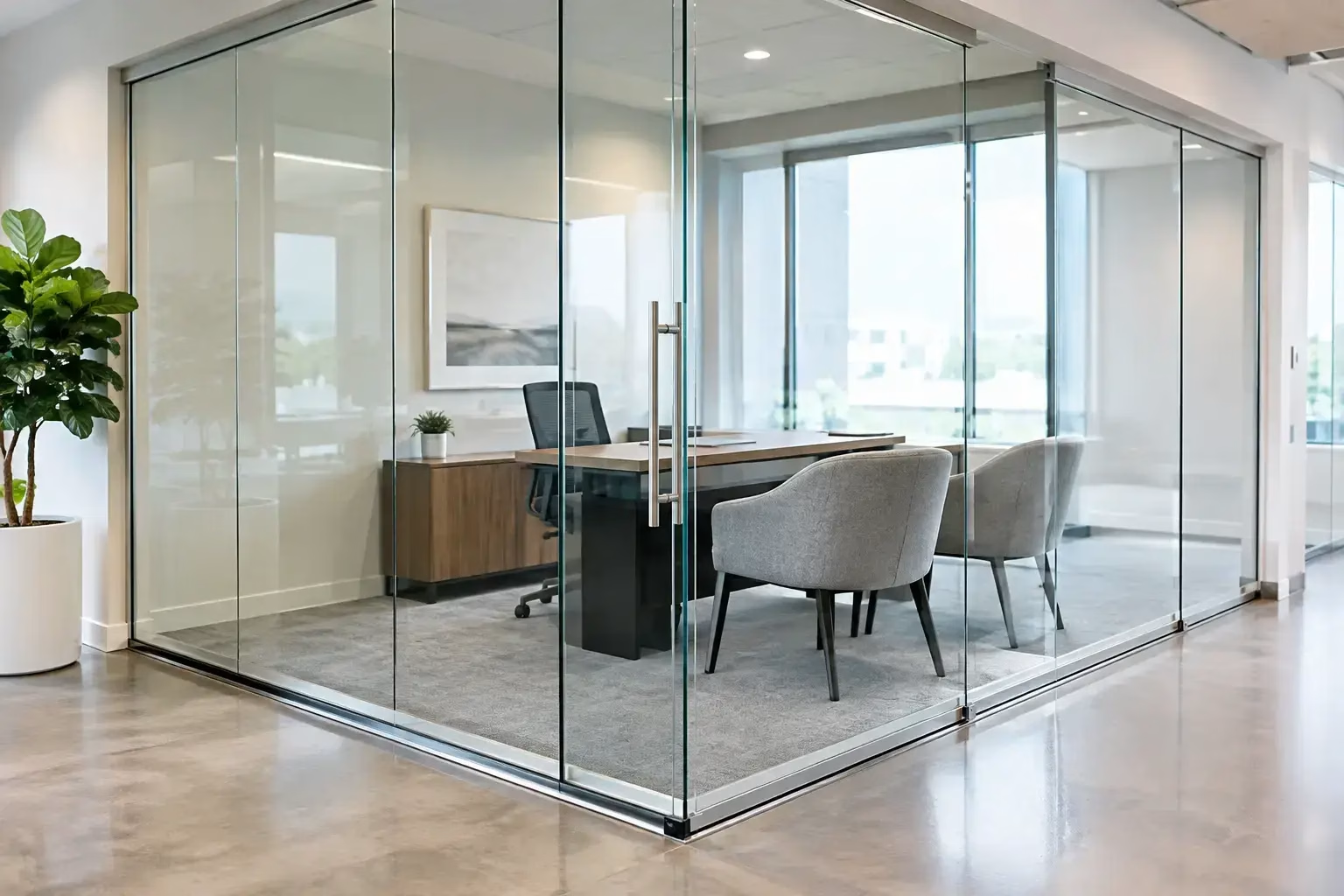
A conference room with glass walls can look open, refined, and connected to the rest of the workplace. But are glass office walls private when sensitive conversations, focused work, and client meetings are happening inside? The practical answer is yes, when the system is specified for the kind of privacy the room actually needs.
Privacy is not one feature. It has three distinct dimensions: visual privacy, acoustic privacy, and confidentiality. A clear glass partition may support an open culture while offering little visual screening. A frosted panel can block sightlines but does not stop a voice from traveling. A well-engineered glass office system addresses each requirement through glass selection, framing, doors, seals, layout, and operational details.
Are Glass Office Walls Private Enough for Work?
For most offices, glass walls provide the right level of privacy when they are matched to the space. Executive offices, meeting rooms, focus rooms, HR areas, and client-facing conference rooms do not all need the same solution. The design question is not whether glass is inherently private or not. It is what must be private in that room, and how often.
A standard clear tempered-glass partition creates a physical boundary and reduces everyday office noise, but it should not be treated as a soundproof enclosure. People outside may still hear portions of a conversation, especially when the room has an open ceiling, an undercut door, hard floors, or nearby HVAC openings. For routine meetings and collaborative spaces, that may be entirely acceptable. For compensation discussions, legal calls, medical consultations, or financial conversations, a higher-performing acoustic design is the better choice.
Glass has a major advantage over opaque construction: it keeps natural light moving through the floor plan. That improves visibility, makes smaller rooms feel more generous, and reduces the closed-in effect of traditional offices. The goal is not to sacrifice that benefit for privacy. It is to engineer the right balance.
Visual Privacy: Clear, Frosted, or Switchable Glass
Visual privacy is the easiest part of the equation to control. Clear glass preserves openness and allows managers and teams to see whether a room is occupied. It works especially well for conference rooms, huddle spaces, and offices where transparency is part of the workplace culture.
When occupants need screening, frosted or decorative privacy film can be applied in bands, gradients, or full-height coverage. Partial frosting is often the most efficient choice. It shields seated occupants, monitors, and tabletop materials while keeping the upper glass clear to retain daylight and visual connection.
For rooms that need on-demand privacy, switchable glass is another option. It can shift from transparent to opaque at the press of a control. This is a premium solution for executive meeting rooms, client presentation areas, and multipurpose spaces where the use of the room changes throughout the day.
Visual treatments should be selected with the room’s use in mind. A fully frosted wall may provide privacy, but it can also make a compact office feel more enclosed. A carefully placed frosted band often delivers the more polished result.
Acoustic Privacy Depends on the Entire System
The most common misconception about glass office partitions is that thicker glass alone determines sound control. Glass thickness matters, but acoustic performance depends on the complete enclosure. Sound travels through every available path, including door gaps, ceiling conditions, floor transitions, wall connections, and mechanical penetrations.
A high-performing private office or conference room typically combines laminated acoustic glass with perimeter seals, properly designed door seals, and partitions that extend to the structural deck where confidentiality is required. Laminated glass uses an interlayer between glass sheets that helps dampen vibration and improve sound control compared with a single pane. The result is a quieter, more composed room without losing the clean architectural look of glass.
Door selection is equally important. A sliding glass door is an elegant, space-efficient solution, but a swinging door with acoustic seals generally provides a tighter closure when speech privacy is the priority. That does not make one format universally better. It means the door should be chosen based on how the room will be used.
An open ceiling is another major consideration. Partitions that stop below an exposed ceiling can look modern and reduce installation complexity, yet sound can pass over the top of the wall. This approach is suitable for collaborative zones and casual meeting areas. For rooms where confidential speech is expected, full-height systems with appropriate head conditions provide more reliable performance.
What Glass Walls Can and Cannot Do
A well-specified glass wall can reduce speech distraction, define a room, create visual privacy, and support more productive meetings. It cannot make an inadequately detailed room confidential simply because the glass looks substantial.
If a project requires high speech privacy, define that requirement early. Architects, facility managers, and installers should consider the room’s target acoustic performance before selecting the partition. Retrofitting seals, changing doors, or extending walls after installation can cost more than planning the right system from the start.
Design Choices That Improve Privacy
Privacy improves when glass partitions are treated as part of a complete interior plan rather than a standalone product. Start by locating private rooms away from the noisiest circulation paths, break areas, copy stations, and reception zones. A conference room placed beside a busy corridor will need more acoustic support than one positioned in a quieter office wing.
Inside the room, soft finishes make a measurable difference. Carpet, acoustic ceiling treatments, upholstered seating, wall panels, and curtains absorb reflected sound and reduce the sharp, echoing quality that can make conversations easier to overhear. These finishes also improve speech clarity for people inside the room.
Outside the room, sound masking can add another layer of discretion. A controlled, low-level background sound makes distant speech less intelligible without creating a distracting environment. It is particularly effective in open-plan offices where several meeting rooms share a common circulation area.
For visual privacy, consider sightlines before finalizing the layout. A room facing a reception desk, elevator bank, or open workstation area may need frosted bands in different locations than a room facing an exterior wall. Screen orientation matters too. Positioning monitors away from direct views through the glass protects information without changing the architecture.
Demountable Systems Make Privacy Easier to Plan For
Business needs change. A two-person office may become a focus room, a larger conference room may need to divide into smaller meeting areas, or a growing team may require more enclosed space. Demountable glass systems give organizations the ability to reconfigure without treating every future change as a full construction project.
That flexibility matters for privacy planning. Instead of choosing permanently between an open office and a fully built-out floor plan, a business can create enclosed spaces where concentration and confidentiality are needed most. Panels can be relocated, rooms can be resized, and privacy treatments can evolve with the organization.
Doors22 designs custom demountable glass office systems for this kind of long-term flexibility. Precise sizing, safety-focused engineering, quiet operation, and installation coordination help teams create glass-enclosed rooms that perform as well as they look.
Choosing the Right Level of Privacy
The best specification begins with a direct conversation about use. Ask whether people need visual screening, whether normal conversation must remain private, and whether the room will host confidential discussions. Then evaluate ceiling height, door style, nearby noise sources, HVAC pathways, and the materials already present in the space.
For an open collaboration area, clear tempered glass and a clean sliding door may be the ideal solution. For a manager’s office, partial frosting and improved seals can create a more balanced environment. For HR, legal, executive, or client-confidential rooms, laminated acoustic glass, full-height construction, and a tightly sealed door are usually worth the investment.
Glass office walls are not an all-or-nothing privacy decision. With the right design, they can deliver daylight, visibility, flexibility, and the discretion people need to do their best work. Build the room around the conversations it must protect, and the finished space will feel intentional from every angle.
 Share this post with others


