
How to Select Glass Opacity for Any Interior
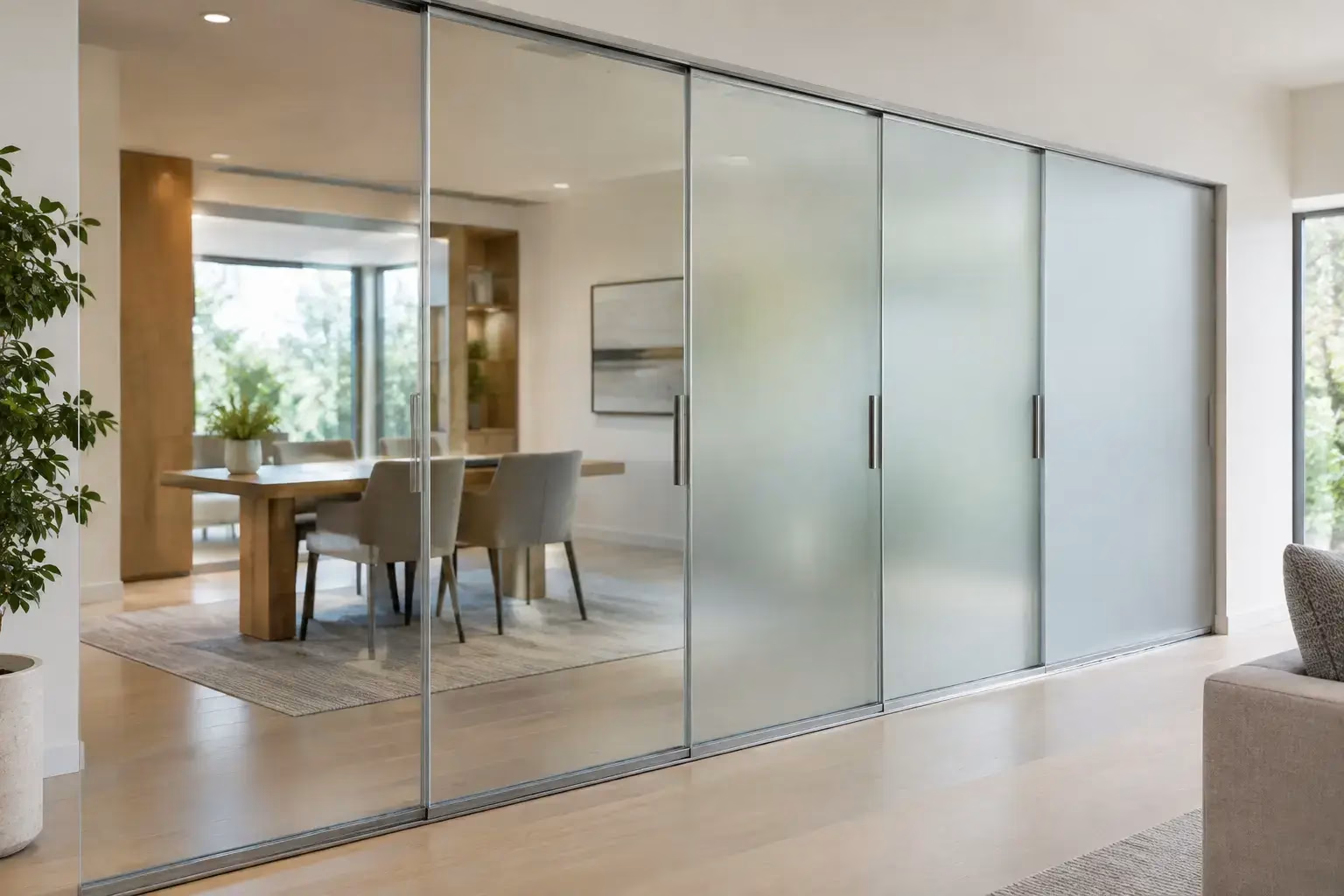
How to Select Glass Opacity for Any Interior
A glass wall can make a compact office feel twice as large, but the wrong finish can leave employees exposed, conference calls visible, or a home office too distracting to use. Opacity is the decision that determines whether a glass system feels open and connected or controlled and private. Knowing how to select glass opacity starts with defining what people need to see, what they need to hide, and how the space needs to perform every day.
For commercial offices, salon suites, meeting rooms, and residential interiors, the strongest choice is rarely fully clear or fully frosted glass throughout. The right specification usually combines daylight, sightlines, privacy, and the visual character of the surrounding architecture.
Start With the Type of Privacy You Need
Privacy is not one requirement. A private office may need visual separation from a busy corridor but still benefit from visible movement and borrowed light. A conference room may need occupants concealed during sensitive meetings, while a salon suite may require dependable client privacy from every angle. A bedroom divider, meanwhile, might need to obscure the room entirely without making it feel enclosed.
Before selecting a finish, identify the activity on each side of the glass. Consider whether people are working at desks, holding confidential discussions, receiving clients, changing clothes, sleeping, or simply passing through. Then determine the viewing distance. A lightly frosted panel can obscure details from across a hallway, but shapes and motion may remain visible at close range.
It also matters whether privacy must work continuously or only at certain times. A leadership meeting room may need a clear visual connection most of the day and additional screening during presentations. A home office may need clarity when it is vacant but stronger separation during video calls. These spaces may benefit from partial frosting, patterned layouts, or a combination of clear and obscured panels rather than a single opacity level.
How to Select Glass Opacity by Room Function
A practical way to select glass opacity is to match the finish to the room’s primary job, not just its appearance in a showroom.
Open offices and collaborative work areas
Clear glass is often the best fit for open-plan offices, internal corridors, and collaborative areas. It preserves natural light, keeps circulation visually intuitive, and supports the open atmosphere many companies want from a modern workplace. Clear partitions also allow managers and teams to see whether a room is in use without opening a door.
The trade-off is exposure. Clear glass can make focused work difficult when a desk faces a high-traffic hallway. In this situation, a frosted band at seated eye level can provide meaningful relief while leaving the upper glass clear for daylight and openness.
Conference rooms and executive offices
Conference rooms often need layered privacy. A fully clear enclosure looks refined and can make a small meeting room feel less confined, but it may not be appropriate for financial reviews, personnel discussions, or client presentations. Frosting across the center portion of the glass is a common solution because it blocks direct views into the room while maintaining a bright upper zone.
For executive offices, consider how much visual connection supports the organization’s culture. A clear front wall can communicate accessibility. Frosted lower panels or side panels can reduce distraction and give the occupant a more controlled working environment.
Salon suites and wellness spaces
Salon suites, treatment rooms, and wellness spaces need a higher level of visual separation. Full frosted or opaque glass may be the right answer where clients expect discretion. If daylight is limited, translucent glass remains preferable to solid walls because it can distribute light without exposing the room.
Do not assume that a lightly etched surface provides full privacy. Request a sample and view it under the lighting conditions expected in the finished space. Backlighting can reveal more silhouette and movement than anticipated.
Home offices, room dividers, and closets
Residential spaces often benefit from a more selective approach. Clear sliding glass doors can define a home office while keeping a living area bright and visually spacious. However, if the room is used for calls, study, or focused work, a frosted center band can reduce distractions from the adjacent space.
For closets and bedroom dividers, frosted glass conceals storage and softens visual clutter. A reeded or patterned glass option can add texture while retaining a degree of light transmission. The best choice depends on whether the goal is complete concealment or simply a cleaner visual boundary.
Understand Clear, Translucent, and Opaque Options
Clear glass provides the highest visibility and light transmission. It is ideal when the glass system is intended to create boundaries without interrupting the room’s visual flow. It is also the easiest finish to coordinate with modern metal hardware, minimalist interiors, and clean architectural lines.
Translucent glass, often described as frosted, etched, or acid-etched, transmits light while diffusing views. This is the most versatile category for commercial interiors because it balances brightness with privacy. The level of diffusion can vary significantly, so two products described as frosted may perform very differently in real conditions.
Opaque glass blocks views almost completely and delivers the strongest visual privacy. It can be useful in sensitive rooms or areas where glass is being used primarily for its sleek profile and door system performance rather than transparency. The cost is reduced light flow, which may make an enclosed room feel more solid and less connected to the rest of the interior.
Patterned and reeded glass sit between clear and frosted options. They distort sightlines, add architectural texture, and can conceal detail without fully blocking light. Their privacy level changes with the pattern depth, viewing angle, and lighting. They are a design-forward choice, but they should be evaluated for performance rather than selected on appearance alone.
Account for Light Direction and Nighttime Conditions
Opacity looks different in a bright showroom than it does in a finished office at 7 p.m. When one side of the glass is brightly lit and the other side is dark, silhouettes are more visible through many translucent finishes. This is especially relevant for exterior-facing rooms, after-hours offices, and residential rooms with uneven lighting.
Review the lighting plan before finalizing the glass. Consider windows, overhead fixtures, task lighting, display lighting, and the direction people will approach the partition. A privacy finish that works during daylight may need additional coverage or a denser finish for nighttime use.
Glare also deserves attention. Clear glass near strong sunlight can create reflections that interfere with screens and meetings. Frosted glass can diffuse harsh light, but it may also brighten a room unevenly. The answer may be a measured combination of glass opacity, window treatments, and workstation placement.
Do Not Confuse Visual Privacy With Acoustic Privacy
Frosted glass prevents people from seeing into a room. It does not stop them from hearing a conversation. This distinction is critical for conference rooms, HR offices, therapy rooms, and executive spaces.
Acoustic performance depends on the complete system: glass thickness, seals, door design, framing, gaps at the perimeter, and installation quality. A visually private room can still be acoustically exposed if the door perimeter is not properly sealed or if the partition does not extend and connect correctly to the surrounding structure.
When confidential speech is a priority, specify opacity and acoustics as separate requirements. A premium glass partition should be engineered for safety and performance, while the layout and enclosure details should support the level of sound control the room requires.
Choose a Finish That Works With the System Long Term
Glass opacity should support the flexibility of the space. Demountable glass partitions are designed to adapt as teams grow, offices reorganize, or room functions change. A finish that is too specific to one use may limit future options.
Applied film can be a practical choice when privacy needs may change over time, such as a leased office or an evolving workplace. Permanent etched or frosted glass creates a more refined, durable appearance and avoids concerns about peeling, bubbles, or edge wear. The right decision depends on budget, expected lifespan, and how often the layout may be reconfigured.
For sliding glass doors, confirm that the selected finish aligns with the door’s sightlines, hardware, and surrounding panels. A carefully placed frosted pattern can make a sliding door feel intentional when closed and still look clean when panels stack or overlap.
Use Samples and Sightline Testing Before You Order
A glass sample is not a minor detail. It is the fastest way to avoid a finish that feels too transparent, too dense, or inconsistent with the rest of the interior. View samples in the actual space whenever possible, at standing and seated height, from both sides of the partition, and under daytime and evening lighting.
Test practical questions. Can someone in the corridor read a screen? Can they identify a person in the room? Does the frosted area block a seated worker’s view, or does it sit too high? Does the pattern clash with flooring, wall finishes, or furniture lines?
This step is particularly valuable for made-to-order systems. Doors22 can help align custom sizing and glass choices with the intended function of a room, so the finished partition is not only visually refined but also built around real use conditions.
The best glass opacity is the one that makes privacy feel effortless rather than restrictive. Specify it around the people, lighting, and activities inside the room, then let the glass deliver the openness, performance, and control the space was designed to achieve.
 Share this post with others


