
How to Divide Open Office Space Effectively
How to Divide Open Office Space Effectively
An open office can look sharp on a floor plan and still fail in daily use. Noise carries, private conversations become public, and teams that need focus compete with teams that need constant collaboration. If you are deciding how to divide open office space, the goal is not to close everything off. It is to create separation with purpose, while preserving light, flexibility, and a clean visual line.
The best office layouts are built around behavior, not just square footage. A sales team, a leadership group, a client-facing conference room, and a quiet work zone do not need the same level of enclosure. Once that becomes clear, space planning gets simpler. You stop asking where to place walls and start asking what each zone needs to perform well.
Start with function before form
The fastest way to make an open office feel cramped is to divide it too aggressively. The fastest way to make it feel chaotic is to leave it completely undefined. Most workplaces need a middle ground.
Begin by identifying the activities happening in the space. Focus work needs acoustic control and visual calm. Meetings need enclosure and a sense of privacy. Reception areas need openness and a polished first impression. Manager offices often need transparency with some separation. Breakout areas need easy access and less formality.
This is where many projects go off track. Businesses choose a divider based on appearance alone, then realize it blocks daylight, limits future layout changes, or creates awkward traffic flow. A better approach is to decide which areas need full separation, which need partial screening, and which only need visual boundaries.
How to divide open office space without losing light
Natural light is one of the biggest advantages of an open plan. Once you start adding traditional construction, that advantage disappears fast. Solid drywall can solve privacy issues, but it often creates a darker, more closed environment and makes later reconfiguration more expensive.
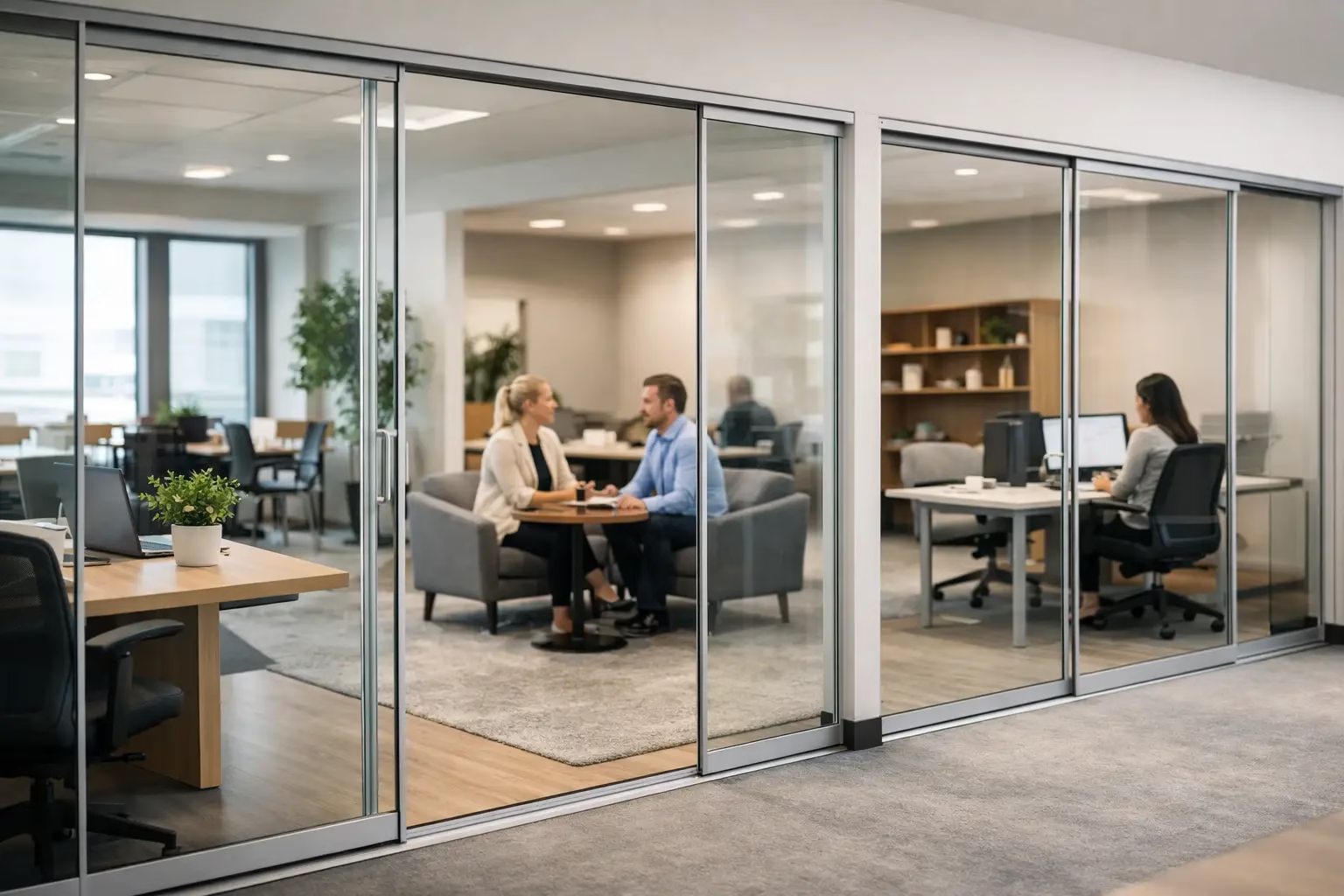
Glass office partitions solve a different set of priorities. They define space clearly while keeping sightlines open and allowing light to travel deeper into the floor plate. For companies that want a modern office aesthetic without sacrificing practical performance, this is usually the smarter balance.
Demountable glass systems are especially useful when long-term flexibility matters. If your team grows, departments shift, or the office footprint changes, movable partition systems make updates far easier than fixed construction. That matters for growing businesses, leased spaces, and offices that need to adapt without major disruption.
Choose the right type of division for each zone
Not every area should be enclosed the same way. A conference room has different demands than a workstation cluster or a private office.
Full-height glass partitions work well when you need strong spatial definition and a more enclosed feel. They are ideal for conference rooms, executive offices, and client meeting spaces where visual sophistication matters and sound control is a priority.
Glass cubicles or L-shape office partition layouts are often a better fit for team workstations. They create personal territory and reduce distraction without making the office feel boxed in. In many cases, they offer enough separation to improve concentration while keeping the floor open and connected.
Sliding glass doors are useful where swing clearance is limited or a cleaner circulation path is needed. In tighter offices, that detail can make a major difference. A sliding system also supports a more streamlined visual profile, especially in modern interiors where every line counts.
If you need occasional privacy rather than constant enclosure, partial divisions may be enough. The right answer depends on how people actually use the office, not just how the office looks during a walkthrough.
Think about acoustics early
Open offices rarely fail because of appearance. They fail because of sound.
That is why acoustic expectations should be addressed at the planning stage. Glass will not perform the same way in every application, and not all partition systems are engineered equally. If privacy is critical in leadership offices, HR rooms, or conference areas, the partition design, door system, and surrounding construction all matter.
Silent operation matters too. A divider that looks premium but rattles, drags, or slams will quickly feel like a compromise. Well-designed sliding and demountable systems should support quiet daily use, especially in offices where meetings, calls, and focused work happen side by side.
This is also where quality pays off over time. Systems built for safety and performance tend to maintain alignment better, operate more reliably, and hold up under repeated use. For commercial interiors, durability is not a bonus. It is part of the calculation.
Plan circulation, not just partitions
A divided office still needs to move well. People should be able to reach meeting rooms, desks, and common areas without awkward detours or congestion.
Before finalizing any layout, map the main walking paths. Then look at door placement, sightlines, and bottlenecks. A beautiful conference room enclosure can become a problem if its entry interrupts traffic or crowds a workstation row. A bank of cubicles can improve focus but still fail if it creates dead-end circulation.
Good division makes the office easier to read. People should understand where to go, where to meet, and where to work quietly without needing signs to explain the layout. The cleanest interiors often feel intuitive because the partition strategy supports movement from the start.
Use design to reinforce company standards
The way you divide a space also communicates something about your business. A patchwork of mismatched screens and temporary fixes can make even a premium office feel unfinished. In contrast, a consistent partition system gives the workplace a more deliberate and professional identity.
Glass is often the preferred choice in client-facing offices because it feels refined, modern, and transparent without appearing cold when detailed correctly. It also works across a range of commercial settings, from corporate offices and coworking environments to salons, studios, and home office conversions.
Customization is important here. Standard sizes can work for many applications, but made-to-order systems create a cleaner result when ceiling heights, room widths, or special configurations require precision. Custom sizing also helps avoid the visual compromises that happen when a product is forced into a space it was not designed to fit.
When flexibility should drive the decision
Some companies need permanence. Others need options.
If you expect departmental changes, headcount growth, or layout revisions, fixed construction may become an expensive limitation. Demountable systems are designed for this exact scenario. They give you the structure of defined rooms and partitions without committing the office to one arrangement for the next decade.
This is one reason many designers and facility teams prefer modular glass systems in commercial interiors. They support phased buildouts, future updates, and faster reconfiguration. For leased office space, that can be a meaningful operational advantage.
Doors22 focuses on this category because it meets a practical need that many businesses have right now – create private, high-function spaces without giving up speed, design quality, or future flexibility.
Common mistakes when dividing open office space
The most common mistake is overbuilding. If every area becomes enclosed, the office loses the openness that made the layout attractive in the first place.
The second mistake is underplanning. Freestanding screens and improvised dividers may provide quick relief, but they often create an inconsistent look and weak long-term performance.
Another issue is ignoring installation conditions. Ceiling type, floor levelness, wall alignment, and door clearances all affect how well a partition system performs. A strong result depends on product quality, but it also depends on accurate measurements and a layout that respects real site conditions.
Finally, some buyers focus only on upfront cost. That can backfire if the system lacks durability, safety engineering, or the ability to adapt later. A lower initial price is not always the lower long-term cost.
A better way to approach your layout
If you are deciding how to divide open office space, think in layers. Start with where privacy is essential, where visibility is beneficial, and where flexibility will matter six months from now. Then choose partition systems that support those priorities without fighting the architecture of the office.
For many modern workplaces, glass offers the strongest balance of openness, performance, and professional appearance. It defines rooms, improves organization, and keeps the office bright. When the system is demountable, custom-fit, and engineered for safe, quiet use, it does more than divide space. It makes the office work better.
A well-planned office should feel controlled, not crowded. When each zone has the right level of separation, people focus more easily, move more naturally, and experience the space the way it was meant to function.
.png) Share this post with others
Share this post with others


