
Movable Office Glass Walls That Work Harder
Movable Office Glass Walls That Work Harder
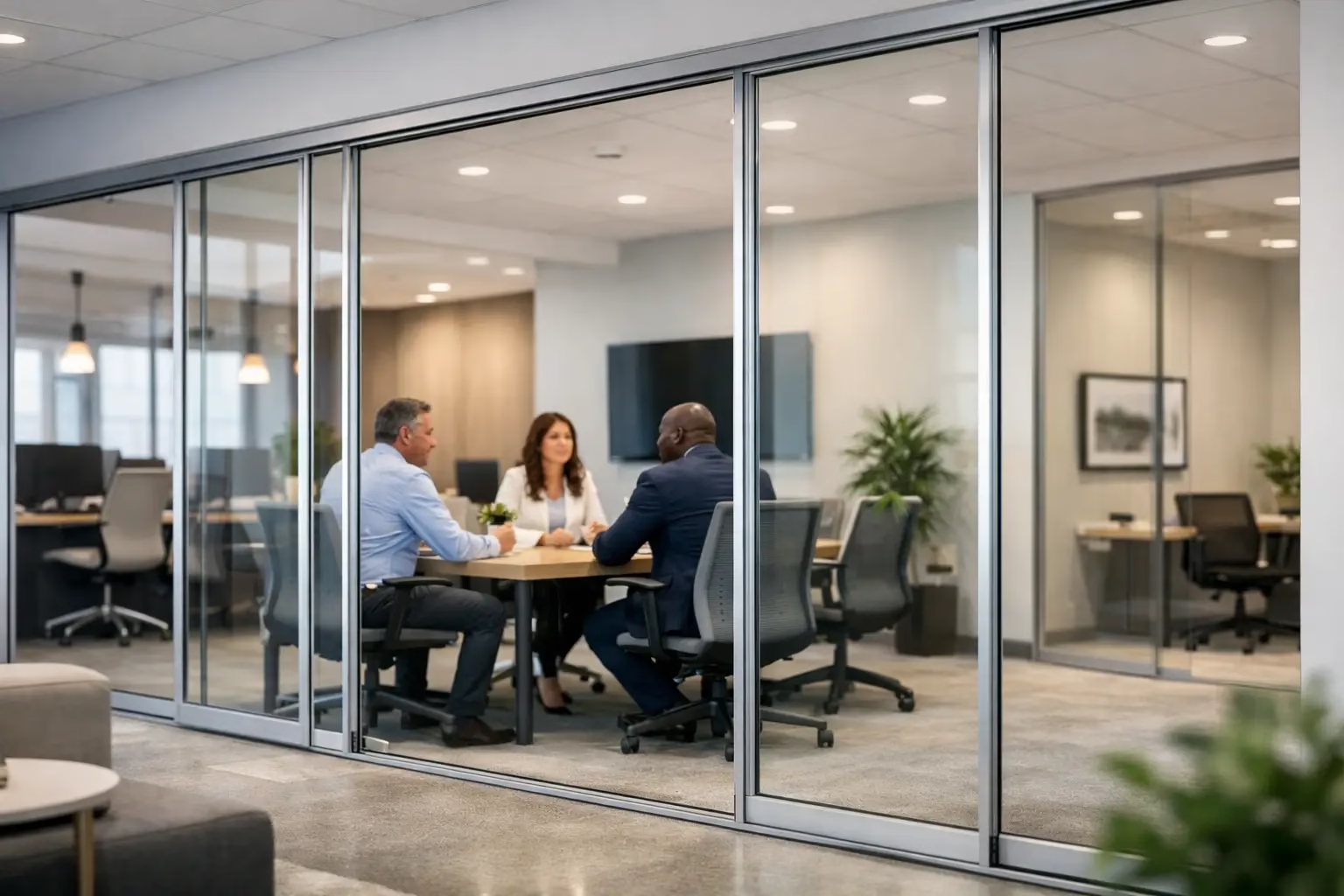
A fixed office layout starts showing its age the moment your team changes. One new department, one extra meeting room, or one shift toward hybrid work can turn a well-planned space into a daily workaround. Movable office glass walls solve that problem with a cleaner, more durable approach – they let you reconfigure interiors without giving up natural light, professional appearance, or long-term performance.
For commercial spaces, that flexibility matters because square footage is expensive and needs change fast. For residential settings, especially home offices and multipurpose rooms, the same principle applies. You want separation when you need focus and openness when you do not. Glass systems make that possible without the heaviness of permanent construction.
Why movable office glass walls make sense now
Traditional framed walls lock you into one floor plan. If your business adds staff, changes workflow, or needs more private rooms, altering those walls usually means demolition, patching, paint, dust, and downtime. Movable office glass walls are designed for a different kind of interior strategy. They support change instead of resisting it.
That does not just help with layout flexibility. It also improves how a space feels and functions day to day. Glass carries light deeper into the interior, which can make offices feel larger, cleaner, and more productive. It preserves visual openness while still creating defined zones for meetings, focused work, client conversations, or private calls.
There is also a brand perception factor. Clients, employees, and visitors notice when a space looks intentional. Glass partitions and demountable systems communicate order, transparency, and modern standards. For companies investing in recruiting, retention, and customer experience, that visual clarity has real value.
What separates a good system from a cheap one
Not all glass wall systems perform the same way. On paper, many products sound similar. In practice, engineering details make the difference between a system that works smoothly for years and one that becomes a maintenance issue.
The first thing to evaluate is structural design. A premium system should be built for safety and performance, not just appearance. Tempered safety glass, stable framing, and secure panel movement all matter. If the system includes movable or sliding elements, the hardware should support quiet operation and controlled motion rather than rattling, sticking, or drifting out of alignment.
The second factor is long-term usability. In busy offices, conference rooms open and close constantly. Home office enclosures may be used every day. That means track quality, wheel design, locking mechanisms, and installation precision are not minor details. They determine whether the system still feels refined after years of use.
Another difference is customization. Standard sizing can work well in some projects, but many interiors need exact measurements. Ceiling conditions, wall returns, room width, and door placement all influence the final result. A system that can be configured to fit the actual space, rather than forcing the space to adapt to the product, usually delivers a cleaner and more professional outcome.
Where movable office glass walls perform best
The most obvious use is in office environments that need adaptable private space. Conference rooms are a strong example. Teams want visual openness most of the time, but they also need enclosed areas for meetings, presentations, interviews, and video calls. A movable glass system creates that division without making the floor plan feel closed off.
Private offices are another common application. Leadership offices, HR rooms, and client-facing spaces benefit from separation, but solid drywall can make surrounding areas feel darker and more compressed. Glass maintains a connected look while still defining boundaries.
Open-plan workplaces also benefit from modular glass cubicles and partial enclosures. They can reduce distractions, organize departments, and create more intentional workflow paths. The exact configuration depends on how much acoustic control and visual privacy the space needs. That is where product selection matters. Some projects call for full-height enclosed systems, while others work better with simpler partition layouts.
Outside the corporate setting, these systems work well for salon suites, studio spaces, home offices, and residential room dividers. A home office is a good example of where design and practicality intersect. You may need separation from the rest of the home during working hours, but you may not want a permanent wall that closes off light and makes the room feel smaller. Glass gives you that middle ground.
Design benefits are real, but so are the trade-offs
Glass walls are not the right answer for every space, and the best planning starts with that reality. If a room requires maximum sound isolation, full privacy at all times, or utility-heavy wall construction, a glass system may need to be paired with other solutions or evaluated carefully.
Acoustics are one of the main it-depends factors. Glass partitions can significantly improve visual organization and provide a degree of separation, but not every glass wall is intended to perform like a fully insulated permanent wall. For conference rooms and executive spaces, the right configuration can work very well. For highly sensitive environments, acoustic expectations should be defined early.
Privacy is another consideration. Clear glass supports openness and light flow, which is one of its biggest strengths. But some settings call for more discretion. Frosted finishes, strategic placement, and room-specific layouts can help balance transparency with privacy. The point is not to treat glass as one fixed look. A well-designed system should fit the function of the space.
Choosing the right movable office glass walls
Start with the actual use case, not the product catalog. Ask what the room needs to do every day. Does it need to open and close frequently? Is quiet operation important? Will the layout likely change again in two years? Does the space need custom dimensions? Those answers will point you toward the right system faster than aesthetics alone.
For commercial buyers, durability should be high on the list. A product that looks polished at installation but degrades under regular use is not a value. Look for systems designed to last for decades, with hardware and movement components engineered for repeat use.
For design professionals and contractors, installation planning matters just as much. A well-made product still depends on accurate measuring, proper support conditions, and clear coordination. Some projects are straightforward enough for experienced installers to execute quickly, while others need custom planning around existing walls, ceiling conditions, or access constraints.
For homeowners, the main decision usually comes down to how permanent the room division should feel. A movable glass enclosure gives you flexibility without making the home feel compartmentalized. That is especially useful for home offices, guest spaces, and multi-use rooms where one layout rarely fits every situation.
The value of demountable systems
One of the strongest arguments for demountable glass systems is that they protect your investment when your layout evolves. Permanent construction has a one-layout mindset. Demountable systems are different. They are designed to be reconfigured, relocated, or adapted with less disruption.
That has practical value for growing businesses, leased office spaces, and owners who do not want to rebuild every time priorities shift. It can also support better project speed because you are not starting from scratch each time the space changes.
This is where engineering matters again. A demountable system should not feel temporary or light-duty. The best systems combine flexibility with stability, refined detailing, and reliable hardware performance. That is the standard serious buyers should expect.
Doors22 approaches this category with that exact mindset – design-driven products, built for safety and performance, with custom sizing options and movable systems that support long-term flexibility rather than short-term fixes.
What the buying process should feel like
A premium glass wall system should not require guesswork. Buyers need clear sizing guidance, transparent pricing direction, and a realistic understanding of installation requirements. The project may be custom, but the process should still feel efficient.
That matters because most customers shopping for movable office glass walls are solving an immediate space problem. They are trying to add privacy, define a conference room, build a cleaner home office, or create a more polished interior without committing to a rigid layout. The right partner makes that decision easier by offering technical reassurance, practical configuration options, and a path to execution that respects deadlines.
A smart glass wall investment is not only about what the space looks like on day one. It is about whether the system continues to perform, adapt, and justify its footprint over time. If your interior needs to stay open, professional, and ready for change, that is where movable glass earns its place.
.png) Share this post with others
Share this post with others


