
10 Best Office Partition Ideas That Work
10 Best Office Partition Ideas That Work
A noisy open floor plan usually looks efficient on paper. Then the calls start, teams need focus, and the conference room is booked solid by 9 a.m. The best office partition ideas solve that problem without turning a bright workspace into a maze of drywall and dead corners.
For most offices, the right partition is not just about dividing space. It is about controlling sound, preserving natural light, improving circulation, and giving the layout room to change as the business grows. That is why the strongest solutions tend to be modular, durable, and visually clean. If you are planning a new office, renovating an existing one, or upgrading a hybrid workspace, here are the partition ideas worth serious consideration.
What makes the best office partition ideas worth the investment
A partition should do more than mark territory. It should support how people actually work. In practical terms, that means balancing privacy with openness, creating enough acoustic separation for focused work, and maintaining a layout that can adapt over time.
Permanent framed walls still have a place, but they are rarely the most efficient answer for interiors that need flexibility. Demountable systems, sliding glass partitions, and modular enclosed zones give owners and designers more control over future changes. They also tend to deliver a cleaner result when aesthetics matter as much as performance.
Material choice matters here. Solid partitions can improve privacy and reduce visual distraction, but they also block daylight and make smaller offices feel tighter. Glass systems do the opposite. They open up the room, carry light deeper into the floor plan, and present a more refined finish. The trade-off is that not every glass solution performs equally well, especially when poor hardware, weak safety engineering, or thin framing leads to noise, instability, or short service life.
1. Full-height glass office partitions
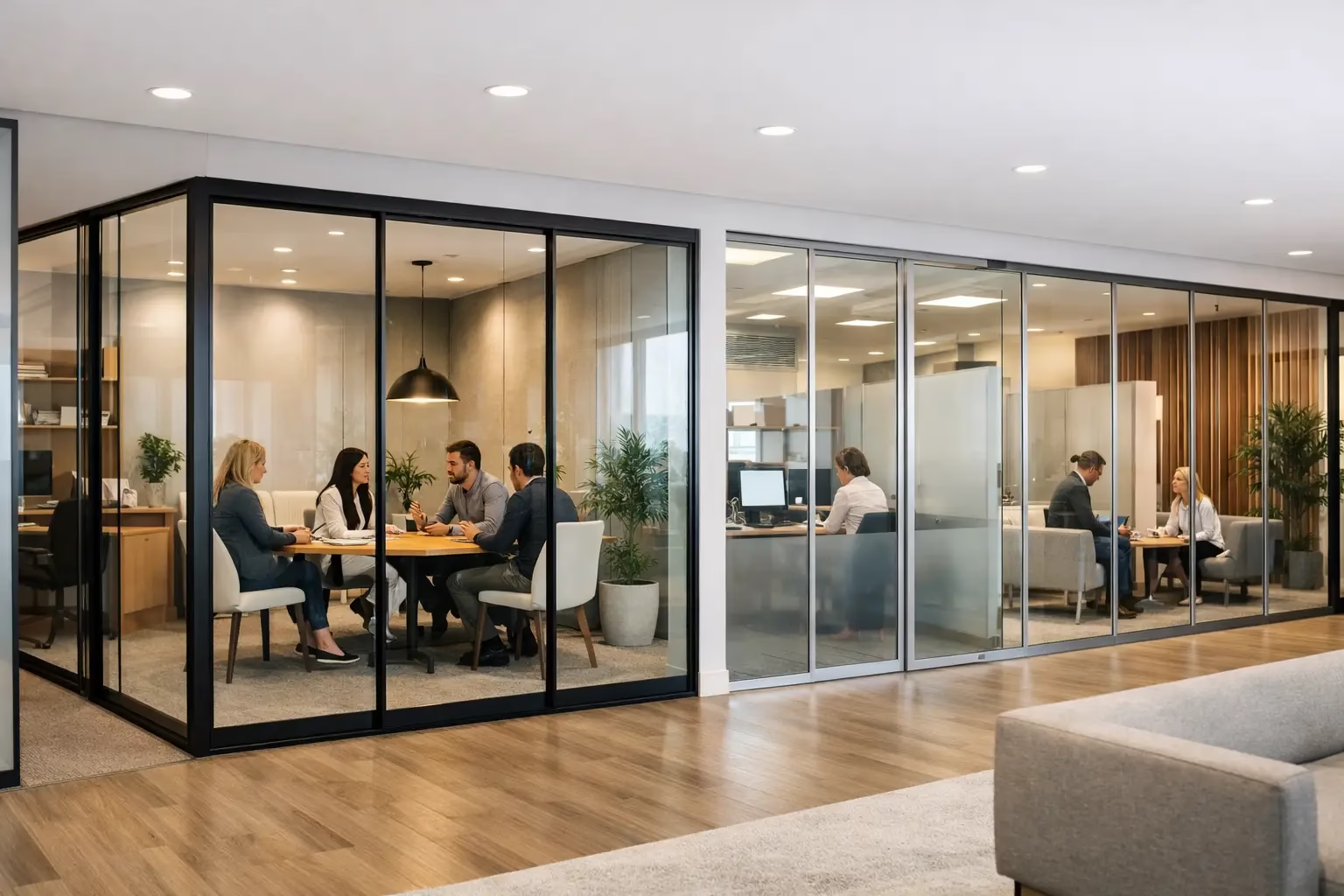
If your goal is a modern office that feels open but still functions as a series of distinct work zones, full-height glass partitions are one of the strongest options available. They create offices, meeting rooms, and team spaces without cutting off visibility or natural light.
This approach works especially well in executive suites, private offices, and perimeter conference rooms where daylight is valuable. It also supports a premium visual standard that many commercial spaces now expect. For clients, staff, and visitors, the space feels intentional rather than improvised.
The key difference is engineering. A well-built glass partition system should be designed for safety and performance, with dependable structural support, quality tempered glass, and hardware that holds alignment over time. In high-traffic offices, that matters more than the initial visual impression.
2. Demountable glass wall systems
Among the best office partition ideas for growing companies, demountable wall systems stand out because they solve today’s layout problem without creating tomorrow’s demolition expense. These systems are built to be reconfigured, relocated, or expanded as teams change.
That flexibility is especially valuable for leased offices, expanding firms, coworking operators, and businesses that expect departmental shifts. Instead of treating partitions as permanent construction, demountable systems turn them into infrastructure that can move with the business.
From a cost perspective, this can be smarter over the long term than repeatedly building and removing conventional walls. From a design perspective, it keeps the office crisp and consistent even as the plan evolves.
3. Sliding glass office partitions
Swing doors need clearance. In compact offices, that wasted arc adds up quickly. Sliding glass partitions use space more efficiently while maintaining a polished, architectural look.
They are especially effective for conference rooms, private offices, and home office enclosures where every square foot matters. In tighter plans, a sliding system can make circulation easier and furniture placement less restrictive. This is not a small benefit. It often determines whether a room feels well planned or cramped.
Performance depends heavily on the track and roller system. A premium sliding solution should operate quietly, stay stable, and resist the rattling or drag that lower-grade systems develop over time. Silent operation is not a luxury in office interiors. It is part of usability.
4. Glass cubicles with defined structure
Traditional fabric cubicles solved one problem and created several others. They added privacy, but they also made offices feel dated, boxed in, and visually heavy. Glass cubicles offer a cleaner alternative.
L-shape and partial-enclosure glass cubicles can define individual work areas while keeping the floor open and bright. This format works well for teams that need personal space without full isolation, such as sales departments, administrative teams, and support staff.
There is a trade-off, of course. Glass cubicles are not the right answer for every role. If the work involves sensitive information or constant confidential calls, a higher level of visual screening may be necessary. But for many offices, they strike a better balance between focus and openness than legacy cubicle systems.
5. Framed partitions for higher visual definition
Not every office wants a minimal all-glass look. Framed partitions provide stronger visual structure and can help align the interior with a more industrial, architectural, or branded aesthetic.
This style is often used when designers want clearer boundaries between spaces or more contrast in the overall scheme. It can also make large offices feel more organized by giving the partition lines greater presence.
The advantage is definition. The compromise is that heavier framing can slightly reduce the airy effect that frameless systems create. Whether that matters depends on the size of the space, the available light, and the design direction.
6. Frosted or partially private glass partitions
Some offices need enclosure without full exposure. Frosted glass, banded privacy film, and mixed-visibility partitions are practical solutions for HR rooms, leadership offices, and meeting spaces where discretion matters.
This is one of the most overlooked office partition decisions. Too much transparency can work against the room’s purpose. At the same time, fully opaque walls may make the space feel disconnected from the rest of the office. A selective privacy treatment gives you both separation and light transmission.
For many teams, that balance is better than choosing either all clear or all solid walls. It keeps the office cohesive while respecting the need for concentration and confidentiality.
7. Modular conference room enclosures
A conference room should not feel like an afterthought built out of whatever space was left over. Modular conference room partitions create dedicated meeting areas with a much higher finish level and far more layout flexibility than conventional construction.
They are ideal for offices that need fast installation, predictable dimensions, and the ability to standardize multiple rooms across one location or several. They also help maintain a consistent design language throughout the workplace.
For decision-makers, this is where modularity has real operational value. If the office needs to add another meeting room, change room size, or update circulation patterns later, the system can often adapt with much less disruption than fixed construction.
8. Multi-use partitions for hybrid offices
Hybrid work changed how offices are used. Fewer businesses need rows of permanently assigned desks. More need flexible zones for touchdown work, video calls, collaboration, and heads-down focus.
That shift makes multi-use partition strategies far more effective than one-size-fits-all layouts. A combination of glass rooms, partial dividers, and sliding enclosures can create a space that works across different occupancy patterns.
The best results come from planning around actual use, not assumptions. A beautiful partition system will still disappoint if it encloses the wrong functions or creates bottlenecks in the floor plan. This is where customization matters. Standard sizes are useful, but exact-measure solutions often produce a better fit and better long-term value.
How to choose the right partition for your office
The best office partition ideas are only as good as their fit for the space. Start with function. Do you need acoustic separation, visual privacy, daylight preservation, or the ability to reconfigure later? Most offices need some combination, but usually one priority should lead the decision.
Next, look at footprint and circulation. Full-height glass walls can be excellent, but they need clean planning around doors, furniture, and walk paths. Sliding systems are ideal when space is tight. Demountable systems are stronger when change is likely. Partial enclosures may be enough when you want light structure without full room build-outs.
Then evaluate durability. Office partitions are used every day, often by many people. Hardware quality, glass safety, locking design, and installation accuracy all affect long-term performance. A system built for safety and performance will cost more than a low-end alternative, but it is also more likely to stay aligned, operate quietly, and look polished years later.
For businesses that want a modern result without sacrificing practical use, custom demountable glass systems are often the strongest fit. Doors22 focuses on this category because it delivers what many offices actually need – refined design, flexible planning, dependable operation, and solutions made to exact measurements when required.
The right partition should make the office feel calmer, brighter, and easier to use from day one. If it can also adapt as your needs change, you are not just dividing space. You are building a better interior.
.png) Share this post with others
Share this post with others


