
Demountable Walls vs Drywall: Which Fits?
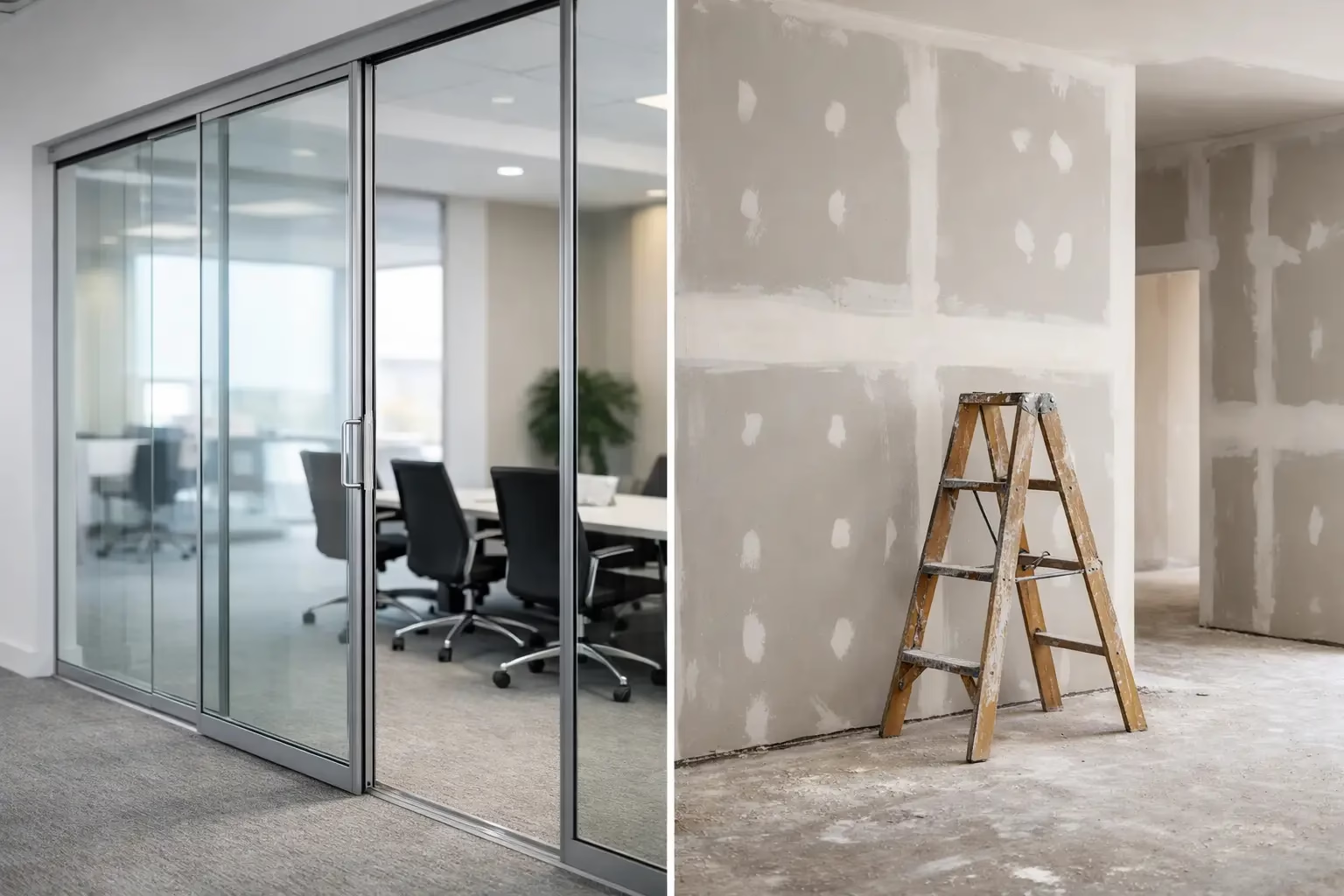
Demountable Walls vs Drywall: Which Fits?
A floor plan can look perfect on paper and still become expensive the moment your needs change. That is where the real demountable walls vs drywall decision starts – not with appearance alone, but with how often a space needs to adapt, how fast it must be built, and what it costs to rework later.
For office owners, architects, facility teams, and design-focused homeowners, the choice is rarely as simple as permanent versus modern. Drywall is familiar, widely available, and often cheaper upfront. Demountable wall systems, especially glass-based systems, are designed for flexibility, cleaner aesthetics, and long-term space planning. The better option depends on what you are building and how long you expect the layout to stay the same.
Demountable walls vs drywall at a glance
Drywall is a conventional framed wall assembly built on site. It typically uses metal or wood studs, gypsum board, joint compound, sanding, painting, and often demolition when the layout changes. It works well when permanence is the goal and future reconfiguration is unlikely.
Demountable walls are prefabricated interior partition systems engineered to be installed, removed, and reconfigured with less disruption. In many commercial applications, they include framed or frameless glass panels, doors, and modular components. Instead of treating walls as fixed construction, they treat walls as part of a flexible interior system.
That distinction matters. If you expect growth, department moves, hybrid work adjustments, or repeated renovation cycles, a movable partition system solves a different problem than drywall does.
The biggest difference is what happens after installation
The first installation is only part of the cost story. Drywall can look economical at the start, but it becomes less efficient every time you need to relocate a room, open up a department, or convert a private office into a meeting room. Demolition creates debris, patching requires labor, and repainting adds more downtime than many teams expect.
Demountable systems are built for those changes. Panels and doors can often be relocated or reconfigured without tearing the interior apart. That is why they are frequently chosen for fast-moving commercial environments, premium office suites, and spaces where layout flexibility is tied directly to productivity.
For residential use, the same principle applies in a different way. A homeowner creating a home office, dividing a loft, or adding privacy without losing daylight may not want a permanent wall that closes off the room completely. A demountable glass system offers definition without making the square footage feel smaller.
Cost: upfront price versus lifecycle value
If the question is strictly initial construction cost, drywall often wins. Materials are relatively inexpensive, and most builders already know the process. For budget-driven builds where the layout is fixed for years, that can be the right call.
But upfront price alone does not tell the full story. Drywall changes tend to trigger a chain of additional expenses: demolition, haul-away, patching, painting, schedule delays, and business interruption. In active offices, that disruption has a real operating cost.
Demountable walls usually require a higher initial investment, particularly when using high-quality glass, engineered hardware, and custom sizing. In return, they reduce waste, shorten future renovation cycles, and preserve more of the original investment when the space evolves. For companies that move teams often, add meeting rooms, or expect growth, lifecycle value can outweigh the higher purchase price.
That trade-off is especially relevant in premium interiors. If your goal is not just to divide space but to maintain a polished, contemporary environment, the finish quality and reusability of a demountable system can justify the spend more clearly than a standard drywall buildout.
Speed and disruption on the job site
Drywall is labor-intensive and sequential. Framing comes first, then board installation, then taping, mudding, sanding, priming, and painting. Drying times and finishing quality affect the schedule. In occupied spaces, that process can be messy and disruptive.
Demountable systems are typically faster to install because much of the work is engineered in advance. Components arrive with defined dimensions, and installation is more assembly than fabrication. That can mean less dust, less noise, and a shorter path to occupancy.
For commercial projects, speed matters beyond convenience. Every extra day of construction can affect staff movement, tenant turnover, and business operations. For homeowners, a faster install often means less strain on day-to-day living.
Design impact: openness versus enclosure
This is where drywall and demountable glass systems separate quickly.
Drywall gives you visual privacy and a solid enclosure. It can be painted any color and integrated into almost any traditional build. If you want a conventional office perimeter or a fully hidden utility room, drywall does the job well.
Demountable glass walls create a different interior experience. They support daylight flow, extend sightlines, and make square footage feel more open. In offices, that often improves the balance between privacy and connection. In residential settings, it helps define space without creating a boxed-in feel.
For brands and homeowners investing in a refined, modern aesthetic, glass partition systems usually deliver a more premium result. They look intentional rather than purely utilitarian. That is one reason design-conscious buyers increasingly choose them for conference rooms, executive offices, salon suites, home offices, and room dividers.
Acoustics and privacy are not all-or-nothing
A common assumption is that drywall always performs better acoustically. In many cases, a fully insulated drywall assembly will provide stronger sound isolation than a standard glass partition. If maximum acoustic separation is the top priority, drywall may still be the stronger option.
But acoustics are not binary. High-quality demountable systems can be engineered for meaningful sound control, especially when the design includes proper seals, quality door hardware, and the right configuration. For conference rooms, private offices, and focused work areas, many buyers find that a well-designed glass system provides the privacy level they actually need while delivering better light and appearance.
The right question is not which material is quieter in theory. It is how much acoustic control your space truly requires, and whether you are willing to trade openness and flexibility to get it.
Sustainability and material waste
Drywall changes are waste-heavy. Once a wall is demolished, much of that material ends up discarded. Rebuilding creates another cycle of waste, labor, and transport.
Demountable systems support a cleaner long-term approach. Because they are intended to be reused and reconfigured, fewer materials are thrown away when a layout changes. That makes them attractive for companies with sustainability goals and for owners who want to avoid rebuilding the same square footage every few years.
This is not just a corporate talking point. Less demolition also means less interruption, less dust, and a more efficient renovation process overall.
Where drywall still makes sense
Drywall remains a practical solution in many projects. If you are building storage areas, utility rooms, back-of-house partitions, or highly permanent layouts, it may be the most sensible material. It is also a strong fit when the budget is tight and appearance, flexibility, and daylight are secondary.
In residential settings, drywall works well for full room separation where transparency is not desired. Bedrooms, bathrooms, and other private zones often call for a traditional wall assembly.
There is no reason to force a modular glass solution where it does not fit the function.
Where demountable walls make the stronger investment
Demountable systems stand out when flexibility, speed, and visual performance matter. They are especially well suited for commercial interiors that change over time, including offices, meeting rooms, coworking layouts, salon suites, and client-facing spaces. They also make sense in homes where owners want separation without sacrificing light.
If your project needs custom sizing, modern sightlines, silent operation, and a system built for safety and performance, a well-engineered demountable glass wall offers advantages drywall cannot match. That is particularly true when the interior is part of the brand experience itself.
For buyers who want a tailored partition system rather than a generic buildout, companies like Doors22 focus on that exact intersection of design, durability, and reconfiguration.
How to choose between demountable walls vs drywall
Start with three questions. How often will this layout change? How important are natural light and visual openness? What is the real cost of disruption if you need to renovate later?
If the answer points toward permanence, full enclosure, and the lowest initial spend, drywall is likely the practical choice. If the answer points toward adaptability, premium appearance, and long-term efficiency, demountable walls are usually the better investment.
The strongest interiors are not built around what is cheapest this month. They are built around how the space needs to perform over time. If your walls may need to move, your budget should think that way too.
.png) Share this post with others
Share this post with others


