
Interior Glass Partitions That Work Harder
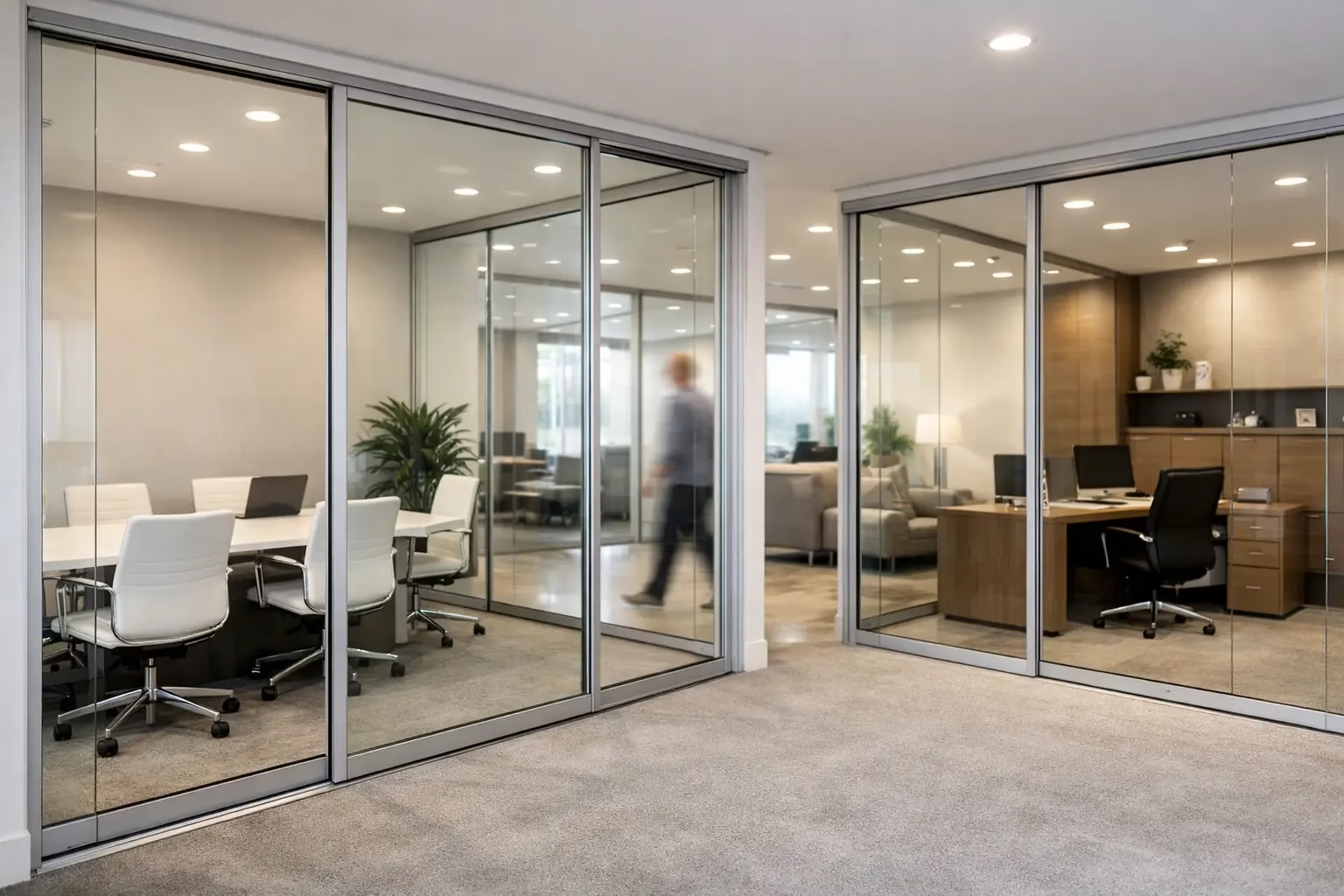
Interior Glass Partitions That Work Harder
The wrong wall can slow a space down. It blocks light, closes off sightlines, and turns a flexible floor plan into something fixed and expensive to change. Interior glass partitions solve that problem by creating real separation without the visual weight of drywall, making them a smart investment for offices, conference rooms, salon suites, and homes that need privacy, structure, and a cleaner use of space.
What makes them appealing is not just appearance. A well-designed glass system can improve how a space performs day to day. Teams stay visually connected while still gaining acoustic separation. Homeowners can define a workspace or divide a room without making it feel smaller. In both settings, the best systems are built for safety and performance, sized correctly, and designed to hold up under constant use.
Why interior glass partitions make sense
Most renovation decisions come down to a few practical questions. Will this improve the layout? Will it last? Will it still work if needs change a year from now?
Interior glass partitions check those boxes better than many traditional built-ins. They preserve natural light, which helps open up interior offices, hallways, and rooms that would otherwise feel enclosed. They also create a more refined look than temporary dividers or basic framed walls, which matters in client-facing environments and design-driven homes.
There is also a flexibility advantage. Demountable systems are especially valuable when a business expects growth, reconfiguration, or tenant improvements. Instead of tearing out permanent construction, the partition system can be adjusted, relocated, or expanded. That can reduce disruption and protect the original investment over time.
For residential projects, the value is similar but the priorities shift slightly. Homeowners usually want separation without heaviness. A home office, bedroom niche, closet opening, or multipurpose room often needs more structure, but not a full opaque wall. Glass can create a clear boundary while keeping the room bright and visually open.
Where interior glass partitions perform best
In commercial settings, these systems are often used to create private offices, meeting rooms, executive spaces, salon suites, and L-shape workstations. They work particularly well where light transfer and a modern presentation matter. If a company wants the openness of an open plan without the noise and lack of privacy that often come with it, glass partitions offer a more balanced approach.
Conference rooms are a strong example. A solid wall can make a room feel closed off and disconnected from the rest of the office. Glass keeps the space integrated with the overall environment while still providing a dedicated area for meetings. Depending on the system, privacy can be adjusted through design choices such as glass type, frame finish, and door configuration.
In residential applications, room dividers and sliding glass systems are often chosen for home offices, walk-in closets, loft-style layouts, and shared living areas. They are especially effective in homes where square footage needs to work harder. Rather than giving up openness to gain function, homeowners can have both.
The real trade-offs to consider
Glass is not a perfect answer for every project, and the right decision depends on what the space needs most.
If maximum sound isolation is the priority, glass partitions can help, but performance depends heavily on the system design. The thickness of the glass, the framing, the door style, and the quality of installation all affect the result. A well-engineered enclosed system can provide meaningful acoustic separation, but it will not perform the same way as a heavily insulated structural wall in every case.
Privacy works the same way. Clear glass creates openness and visibility, which is often the point. But not every room benefits from full transparency. Some offices, treatment spaces, or residential areas may need partial obscurity or strategic placement. That does not mean abandoning glass. It means selecting a system that fits the use case instead of choosing based on appearance alone.
Budget is another factor. Premium interior glass partitions usually cost more upfront than a basic framed wall or an off-the-shelf divider. But the comparison should be honest. A custom demountable glass system offers a different level of finish, flexibility, durability, and long-term value. For clients who care about appearance, reusability, and daily performance, the investment often makes sense.
What separates a premium system from a basic one
Not all glass partition systems are engineered to the same standard. That matters more than many buyers expect.
A premium system starts with safety. In high-use spaces, the hardware, panel stability, and door mechanics need to be designed for real-world wear. Tempered safety glass, secure track performance, and dependable locking features are not extras. They are part of what makes the system viable over time.
Movement is another major differentiator. Sliding systems should operate quietly and consistently. If the door drags, rattles, or loses alignment, the experience of the entire space drops quickly. Silent operation is not just a luxury detail. In offices, homes, and client-facing interiors, it changes how the room feels every day.
Customization also matters. Standard sizes are useful for speed and cost control, but many projects need exact dimensions to align with existing walls, ceiling conditions, or layout goals. A made-to-order system can solve problems cleanly and avoid the compromised look that comes from trying to force a standard product into a custom environment.
Then there is the question of permanence. Traditional construction is fixed. Demountable systems give clients another option. They can create finished, architectural spaces without giving up future adaptability. That is a practical advantage for growing companies, landlords, and homeowners planning for change.
Planning the right interior glass partition system
The most successful projects start with use, not style. Before selecting finishes or door types, it helps to define what the partition must do.
Is the main goal privacy, light transfer, or traffic flow? Does the room need a swinging door or a sliding solution to save space? Will the system stay in place for years, or is reconfiguration likely? These questions shape the specification more than aesthetics alone.
Ceiling and floor conditions should also be considered early. Some spaces have structural limitations, uneven surfaces, or existing design elements that affect installation. Accurate measurements are essential, especially for custom systems. Even a visually minimal design depends on precise engineering behind the scenes.
Commercial buyers should also think about how the partition supports workflow. A beautiful office wall is not enough if it interferes with circulation, compromises privacy in the wrong areas, or creates maintenance issues. Residential buyers should evaluate how the system fits daily routines, including cleaning, child safety, pet access, and furniture placement.
This is where a specialized manufacturer tends to provide a better result than a generic supplier. Product knowledge, custom sizing, technical guidance, and installation coordination all matter when the goal is a polished finished space, not just a panel of glass.
Design impact without wasted space
One reason interior glass partitions continue to gain traction is simple. They make efficient use of space while raising the visual standard of the interior.
In offices, they help create order without making the layout feel dense. In homes, they divide areas without shrinking them. That combination is difficult to achieve with many other materials. Glass allows boundaries to exist without dominating the room.
The effect is especially strong in spaces with limited natural light or compact footprints. When light can travel deeper into the layout, the entire interior feels more usable. That is not just a design benefit. It changes how people experience the room over the course of a workday or at home.
For buyers who want a system that is built for safety and performance, designed to last for decades, and flexible enough to support future changes, this category stands out for good reason. Doors22 focuses on that intersection of engineering, customization, and clean architectural design.
The best partition is the one that solves a real spatial problem and still looks right years later. If your space needs more privacy, better flow, and a sharper finish, glass is often the smarter wall.
.png) Share this post with others
Share this post with others


